
In brief
Which one fits your team
When Hypotize fits
Choose Hypotize when more than one person decides what to test. Invite the team with a link, let everyone vote in ICE, PIE, or RICE, and work in views made for experiments instead of building them. Tests cannot reach Ready without a hypothesis and a metric, or close without a result and a learning, and your agent reads every learning before it proposes the next test. Contributors and viewers are free; a team of 3 pays $39/month.
When Notion fits
Notion is enough if one person runs a handful of experiments, nobody else needs to vote on what comes next, and the tracker should sit next to the rest of your docs.
Notion: what is a database?Notion: database propertiesBuilt for AI agents first
The agent-native Growth OS
Hypotize gives your AI agent the full stack of a growth hacker: the method, the tools to apply it, and rules it cannot bend. Most experiment tools are trackers designed for people clicking through a web app, and some now add AI inside that app. Hypotize starts from the other side: it is a growth-experiment framework your AI agent runs. Claude, ChatGPT, Grok Bot, Cursor, Codex, or any MCP client finds what the team already tested, adds and scores ideas, moves tests through their stages, and records outcomes and learnings, inside the conversation you are already having.
- Framework
- The method: hypothesis-first ideas, ICE, PIE, RICE, or your own scoring, enforced stages, and a measured result with a written learning at the end of every test.
- MCP server
- The tools your agent uses to read and update the record.
- Skills
- Three skills that teach the agent the method before it acts: running experiments, the weekly review, and importing an existing backlog.
- Plugin
- One install for Claude Code and Codex that brings the MCP server and the skills together.
- App
- The board, backlog, and learnings your team works in, on the same record as the agent.
The agent follows the same rules as your team, and the server enforces them: no skipped stage, no test closed without a measured result and a written learning. It never touches billing or members, and it deletes only if you grant that scope at connection.
What Notion documents
Notion runs a hosted MCP server. After OAuth, clients such as Claude Code, Cursor, and Codex can search, read, create, and update the pages and databases the user can access. The difference is what the agent finds there. In Notion it finds whatever the database holds, and it can write any value the user could write. In Hypotize it finds a fixed experiment record, and the server refuses a stage it skips or a test it closes without a result.
Notion MCPNotion: database propertiesWhat “agent-native” means and what it does not cover: see the method.
You
The checkout test has run its two weeks. Close it.
Your AI agent
hypotize_experiment_transition
Hypotize refused to close it: a test needs a measured result and a written learning first. I'm pulling the numbers from your analytics.
Your AI agent
your analytics connector
Control converted at 3.1%, the one-page checkout at 3.8%, over 14 days and about 12,000 sessions per variant. A two-proportion test gives p ≈ 0.003, under your 0.05 threshold.
Your AI agent
hypotize_experiment_record_outcome
Recorded the result, the evidence, and the learning, then closed the test as a win. Next time anyone on the team asks about checkout, this result comes back with its numbers.
What the other product is
A real alternative with a different emphasis
Notion is a workspace for docs, wikis, and projects. Its databases hold pages with typed properties and show them as a table, list, board, calendar, gallery, timeline, or chart. That is how most teams build an experiment tracker in it, often starting from a template.
Its audience is any team that already writes in Notion. For experiments, the usual setup is a database with properties for the hypothesis, the score, the status, and the result, plus a page of notes behind each test.
In our own conversations with growth teams, Notion is the tracker named most often. Hypotize does not replace your Notion workspace. It takes over the experiment database, and your agent can keep reading the rest of Notion next to it.
Notion MCPNotion: what is a database?Notion: database propertiesNotion pricingNotion: export your contentWhat teams say
A tracker you build is a tracker you police
Growth practitioners describing their own trackers in public threads on r/GrowthHacking, February and March 2026. Quoted as written and linked to the comment.
“the real cost isn't the tracking, it's the reasoning layer dying. […] months later you're re-running tests you already ran and reached a conclusion on.”
“First thing that breaks is learnings reuse then ownership people rerun the same tests and “next steps” get lost. Notion or Airtable plus Slack works fine until you need auto pulled results and tighter rollout workflows.”
“we started losing track of which experiments were actually teaching us something vs. which were just running because no one remembered to shut them down.”
“a spreadsheet/Notion/Airtable works if you enforce the schema + weekly cadence.”
Each setup works only while someone enforces the schema and keeps it current. In Notion that is people's work. In Hypotize the server enforces the schema and the stages, the team votes in the app, and your agent does the upkeep.
Side by side
Where each one is stronger
Rows about working with an AI agent come first, because that is what Hypotize is built for. Every Notion cell comes from its official pages, reviewed on 22 October 2026 and linked in place. Each row names the stronger side for that criterion, in our judgment, and the line under each Notion cell says where the claim comes from.
Working with an AI agent
Your AI agent works in the record
Even- Hypotize
- Yes, through MCP. Claude, ChatGPT, Grok Bot, Cursor, Codex, and other MCP clients read the backlog and the learnings and update the record.
- Notion
- Yes, through Notion MCP. After OAuth, clients such as Claude Code, Cursor, and Codex can search, read, create, and update the pages and databases the user can access.From their docsNotion MCP
Rules the agent cannot break
Only Hypotize documents it- Hypotize
- Enforced by the server, for people and agents alike. A test cannot move to Ready without a hypothesis, a success metric, a segment, and dates, and cannot close without a result and a written learning that match its outcome.
- Notion
- The agent can write what the user can write. The database properties reference describes no setting that makes a property required, or that blocks a status change until fields are filled.Not in their docsNotion: database propertiesNotion MCP
Shared memory for people and agents
Stronger: Hypotize- Hypotize
- Every person and every connected agent reads the same record of past tests, evidence, and learnings before proposing the next one, so nobody reruns a test that already lost.
- Notion
- An agent can search every page the user can access and connected sources, experiments mixed with everything else. Whether past tests come back as a clean list depends on how consistently the database was filled in.From their docsNotion MCPNotion: what is a database?
A method the agent follows
Stronger: Hypotize- Hypotize
- Three skills teach the agent the method before it acts: running experiments, the weekly review, and importing a backlog. One plugin installs them with the MCP server in Claude Code and Codex.
- Notion
- Notion MCP gives the agent workspace tools: search, read, create, and update. A method for running experiments is not part of it; the workflow is whatever your database and templates describe.From their docsNotion MCP
Built-in AI
Stronger: Notion- Hypotize
- None, by design. The agent you already use does the work, so Hypotize adds no AI bill and your record goes to no model you did not choose.
- Notion
- Stronger here if you want AI inside the tool: Notion Agent, AI Meeting Notes, and Enterprise Search are included from the Business plan, Free and Plus get a limited trial, and Custom Agents are billed in Notion credits.From their docsNotion pricing
Working as a team
Inviting the team
Even- Hypotize
- Share an invite link by email, Slack, WhatsApp, or anywhere else, or send an email invite. Contributors vote and comment, viewers read, and neither is billed on any plan.
- Notion
- Members are billed per seat on paid plans. Guests are free and see only the pages they are invited to: up to 10 on Free, unlimited from Plus. Voting is not a feature, so a guest votes in fields you set up for it.From their docsNotion pricing
Team voting and priority
Only Hypotize documents it- Hypotize
- Every person votes on each idea with sliders for the framework's dimensions, and the priority is computed from the average of the votes. The backlog shows how many people voted and who.
- Notion
- No voting feature is described. A vote per person needs a property per voter or a related votes database, plus a formula to average them, all built and maintained by you.Not in their docsNotion: database properties
Views built for experiments
Stronger: Hypotize- Hypotize
- A backlog filtered by framework, funnel stage, KPI, and tag; a pipeline board where a test reaches Ready only with its checklist complete; learnings searchable by status, confidence, funnel, and period; one view per test with hypothesis, metric, tasks, comments, and outcome; Cmd+K search.
- Notion
- General views: table, list, board, calendar, gallery, timeline, and chart. The fields, filters, and layouts for experiments are yours to design.From their docsNotion: what is a database?
Everything else
Built for
Even- Hypotize
- Growth experiments of any kind, from ads and email to landing pages, pricing, and product, run by a team of people and AI agents on one record.
- Notion
- Everything a team writes: docs, wikis, projects, and databases. An experiment tracker is one database you design yourself.From their docsNotion: what is a database?
Record structure
Stronger: Hypotize- Hypotize
- Fixed fields for hypothesis, owner, score, stage, result, evidence, learning, and next step, the same on every experiment.
- Notion
- Up to 500 typed properties per database and a page of notes behind every record, in whatever shape you design and keep consistent yourself.From their docsNotion: database propertiesNotion: what is a database?
Stages
Only Hypotize documents it- Hypotize
- Enforced stages from idea to outcome. The server rejects a skipped stage, whoever is writing.
- Notion
- A property can group pages into a board view, so a status column becomes a pipeline. Rules on which move is allowed are not described.Not in their docsNotion: what is a database?Notion: database properties
Prioritization
Stronger: Hypotize- Hypotize
- ICE, PIE, RICE, or a custom framework, with per-person votes averaged into the priority.
- Notion
- Number and formula properties can compute ICE or RICE. The formula, the scales, and any per-person voting are yours to build and maintain.From their docsNotion: database properties
Price
Even- Hypotize
- $0 Free (1 member, 1 project); Solo $19.90/month (1 member, unlimited projects); Team $39/month for up to 3 members, $10 per extra member. Connected AI agents never count as members. Unlimited free viewers and contributors on every plan.
- Notion
- Free, Plus, and Business are priced per member per month, Enterprise is custom, and Notion AI is included from Business. Prices on the official page change with the currency, so we link it instead of quoting it.From their docsNotion pricing
Free plan
Even- Hypotize
- $0: 1 member, 1 project, unlimited free contributors and viewers, no time limit.
- Notion
- Free: unlimited blocks for one person, a block limit once 2 or more members share the workspace, 7 days of page history, and buttons-only automations.From their docsNotion pricing
Moving between them
Even- Hypotize
- Connect Notion and Hypotize to the same agent and it moves the database for you: the import skill maps your columns and statuses, shows you the mapping, and imports up to 50 experiments per call once you say yes. Your agent can read every record back out through MCP.
- Notion
- Databases export to CSV, and pages to Markdown, HTML, or PDF, so the source stays portable.From their docsNotion: export your content
See it in the app
Built for experiments, not configured into them
Screens from a demo project. Nothing here is a template you set up: the votes, the gate, and the outcome rules come with the product.
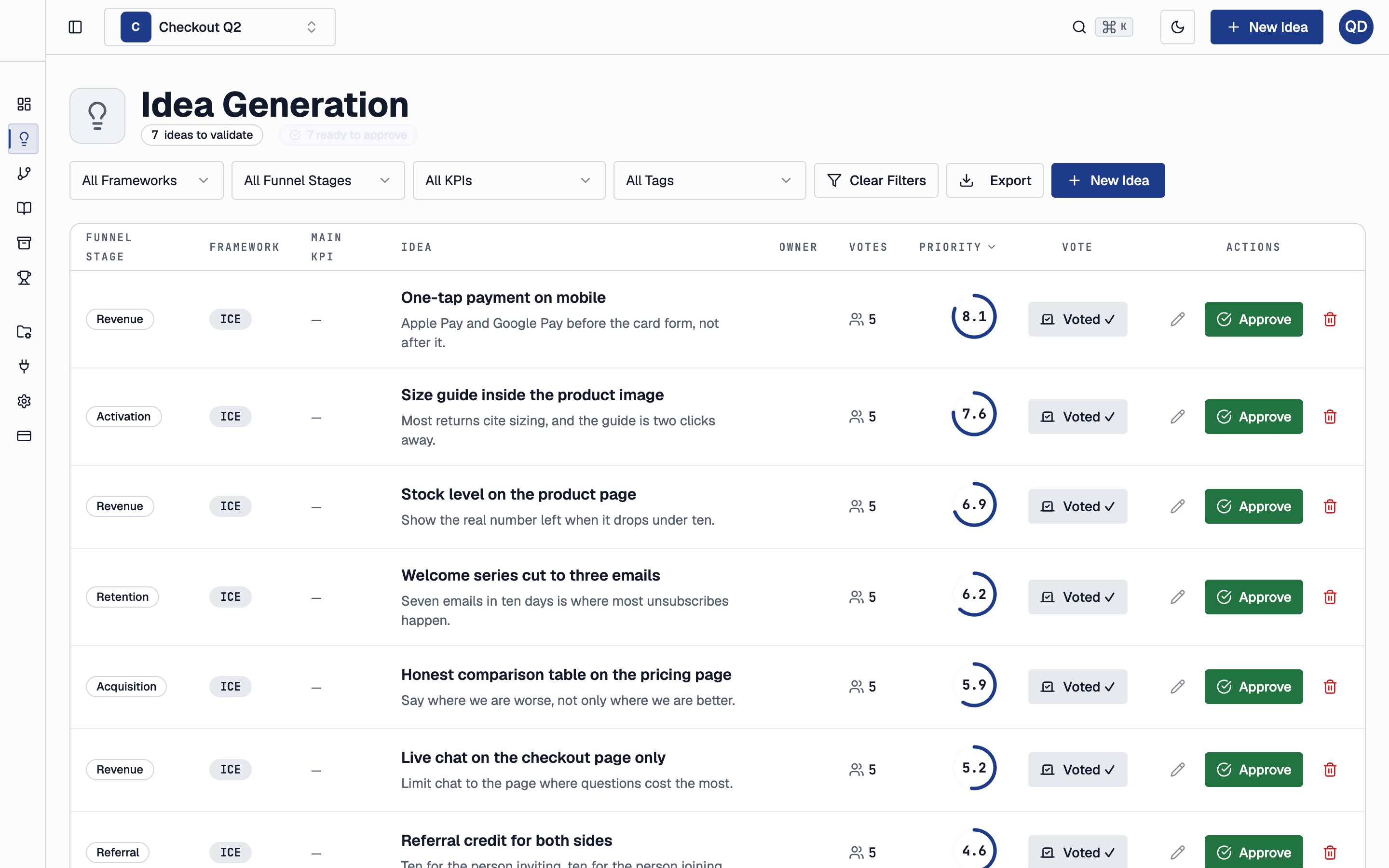
A backlog the team votes on
Every idea with its framework, funnel stage, number of votes, and the priority computed from them.
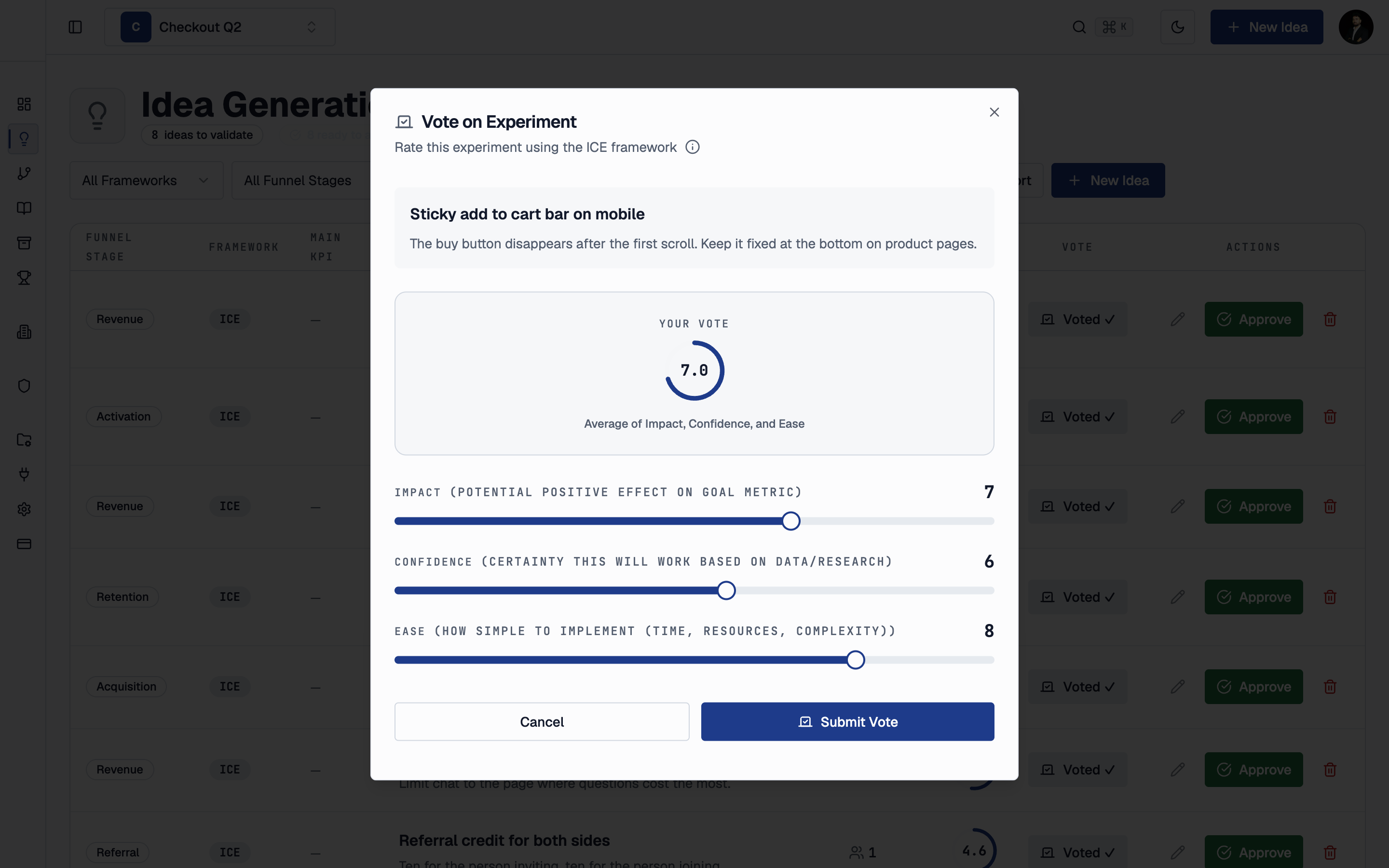
One vote per person
Each person scores the idea with a slider for every dimension of the framework.
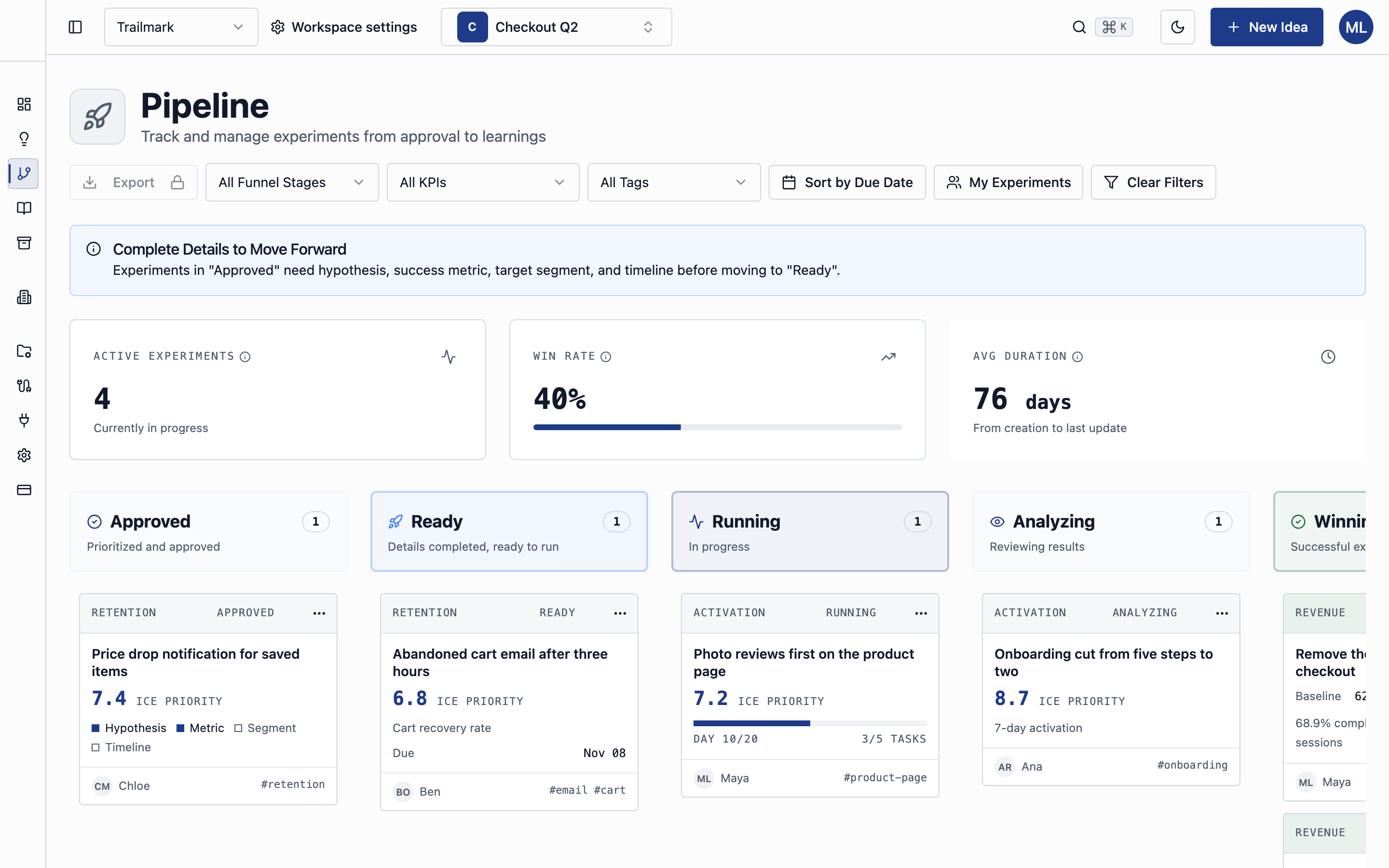
A pipeline with a gate
A test reaches Ready only with its hypothesis, success metric, segment, and dates filled in.
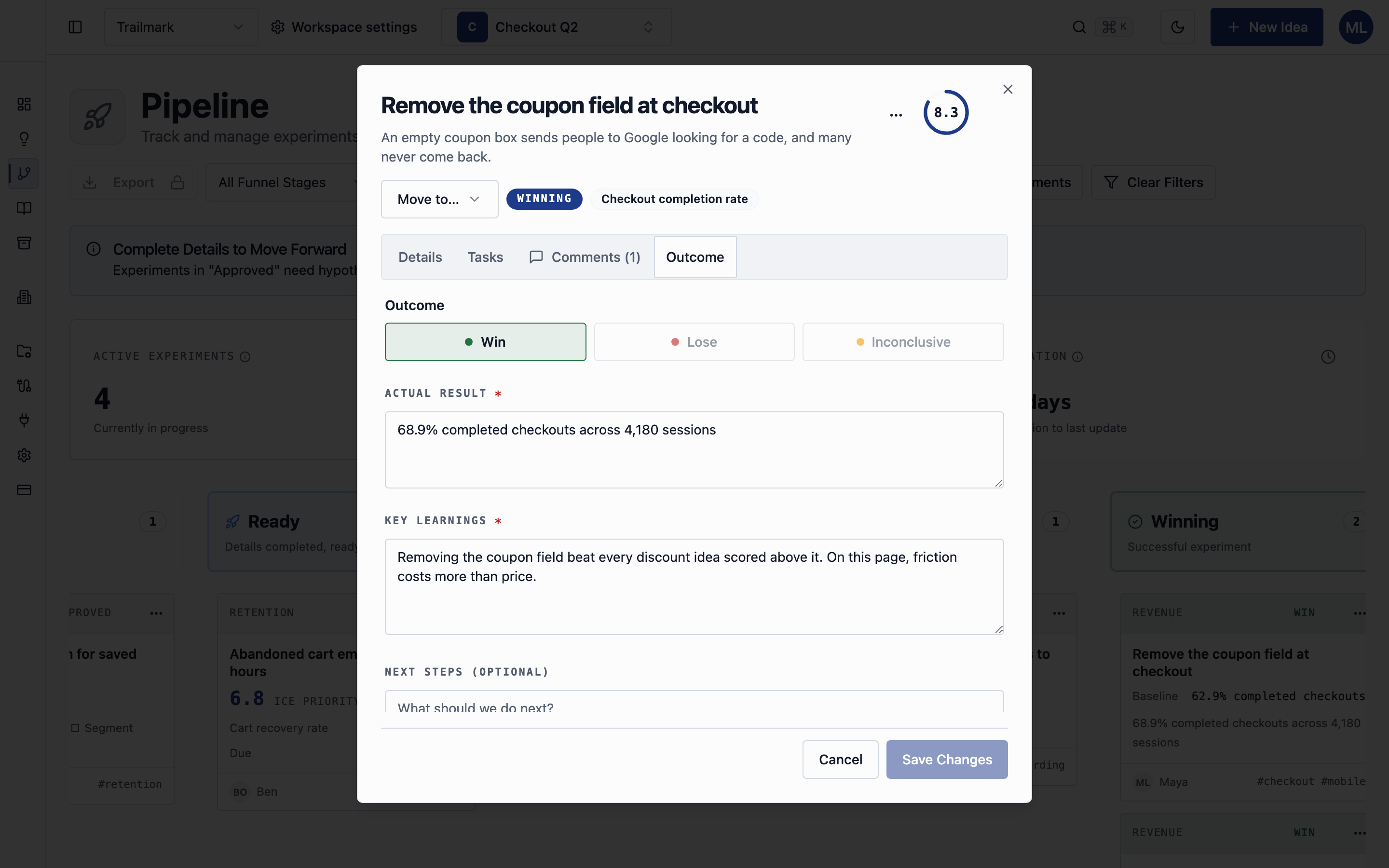
No close without a learning
Closing a test needs the outcome, the actual result, and the learning, from a person or an agent.
From people running it
We test AI ideas daily, and the backlog was always the bottleneck. Now I brainstorm with Claude and the experiments land in Hypotize already scored and prioritized. The tool disappeared into the workflow, which is the best thing I can say about it.
 Chris RubinFounder & CEO, brandmultiplier.ai
Hypotize gave my agency one uniform way to run ideation and experiments across clients. Our AI agents log ideas and results into the same record the team reviews, and the reporting is ready to present internally and to the client without extra work.
 Emanuele Di BiaseHead of Growth, 247x
I manage experiments for multiple clients, and now my AI agent keeps the record for me: it finds what each client already tested and logs every result. I looked for this tool for a long time.
 Gerardo ForlianoDigital Productivity Coach
Data and control
Your data, and what your agent can do with it
- Where your data lives
- On Hypotize's own server at Hetzner in Finland, inside the EU. Backups run every night, and a restore is tested every week.
- What the agent can reach
- Only what your own account and role allow. Every call goes through the same permission checks as the web app, and the agent never touches billing or members.
- Deleting
- Off by default. The agent deletes only if you grant the delete scope when you connect it.
- When the agent gets it wrong
- Everything it writes shows up in the app, where your team edits the idea, the plan, the result, and the learning. To change a closed test's outcome, move it back to Analyzing first. A skipped stage is refused before it happens.
- Switching it off
- Revoke the connection in one click. Access stops at once; no key keeps working until it expires.
- The AI model and its cost
- Hypotize runs no model and adds no AI bill. You use an AI client that connects to MCP servers, such as Claude or ChatGPT, on that client's own plan. The web app works without one.
Switching
Moving from Notion in three steps
Step 1
Connect your agent
Add Hypotize to Claude, ChatGPT, Grok Bot, Cursor, Codex, or any MCP client, starting on the free plan.
Step 2
Hand it your Notion tracker
Your agent reads the database through Notion MCP, or from a CSV export. The import skill maps your columns and statuses, shows you the mapping, and imports up to 50 experiments per call once you say yes. It skips duplicates and never invents a result the source does not contain.
Step 3
Keep the original until you have checked
Nothing is deleted in Notion. Review the imported records first. Your agent can read every Hypotize record back out through MCP, and CSV export covers experiments and learnings.
Method and sources
How this page was written
Reviewed 22 October 2026. This comparison uses only the official public pages listed below and Hypotize's public product references. No Notion account was created or inspected. A capability their pages do not describe is marked “Not in their docs”, which says nothing about whether it exists; “They say it is not available” is used only when the vendor explicitly describes something as unavailable or forthcoming. Each row names the stronger side for that criterion, in our judgment, or says “Only Hypotize documents it” when the other product's pages are silent; there is no overall score or star rating.
The quotes under “What teams say” come from public Reddit threads, each linked to its comment and checked against the thread on 22 October 2026. They describe the authors' own trackers. No capability claim about Notion rests on them.
What “agent-native” means: Hypotize is an operating system for the growth-experiment programme (ideas, priority, stages, outcomes, learnings) built from the start for an outside AI agent: a framework the agent you already use runs through MCP, skills, and a plugin, under rules the server enforces, with no AI of its own. Experimentation platforms that run the tests themselves, such as GrowthBook, Statsig, and Optimizely, offer MCP servers for feature flags and A/B test setup. Hypotize does not run tests: it runs the programme around them, so it works alongside those platforms.
- Notion MCP
Hosted MCP server, OAuth, example clients, search, read, create, and update tools, and admin controls.
- Notion: what is a database?
Databases as collections of pages with properties, and the available views.
- Notion: database properties
Property types, formulas, and the 500-property limit. No required-property setting is described.
- Notion pricing
Free, Plus, Business, and Enterprise plans, Notion AI by plan, Custom Agents credits, and Free plan limits including guests.
- Notion: export your content
Markdown and CSV, HTML, and PDF export for pages and databases.
- Hypotize connected-agent reference
What a connected AI client can read and update, and what stays out of reach.
- Hypotize experiment memory guide
Hypothesis, owner, priority, metric, evidence, outcome, learning, and next step.